
The regulations that apply.
Three pieces of law sit on top of every UK inspection pit: the Workplace (Health, Safety and Welfare) Regulations 1992, PUWER 1998 and the Health and Safety at Work etc. Act 1974. HSE guidance HSG261 ("Health and safety in motor vehicle repair") and INDG293 (vehicle pits leaflet) are the practical compliance documents.
The pit itself is a workplace; the act of getting into and out of it is governed by falls-from-height risk assessment; the work done in it triggers PUWER on lifting equipment, electrical safety regs on lighting and DSEAR on flammable vapours.
Ventilation.
Whether a pit counts as a confined space under the Confined Spaces Regulations 1997 depends on the risk assessment — heavier-than-air vapours such as diesel, LPG, petrol and engine exhaust collecting at the floor of the pit is the usual trigger. Ventilation must be sized to that assessment; 6–10 air changes per hour is a common industry starting point, not a fixed regulatory figure, and running-engine or solvent work needs more.
For LPG / CNG fuelled vehicles a fixed gas detector at the pit floor is strongly recommended. WCCP precast pits ship with cast-in service ducts for the extract, lighting and gas-detector cabling.
Lighting.
Pit lighting is normally 110V or 24V SELV, IP65 rated, with a minimum 200 lux at the working level (HSE recommends 500 lux for detailed inspection work). Floods at 230V mains-voltage are not appropriate in a confined-space environment. Hand-lamps must be low-voltage and intrinsically safe where flammables are stored.
Edge protection and covers.
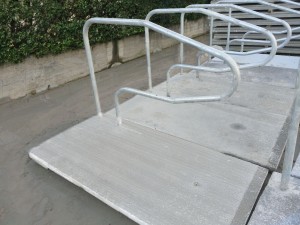
Every open pit needs a continuous trip-rail or steel edge guard. When the pit is out of use, a rigid cover (aluminium plank or steel mesh) is mandatory. Falling-into-pit is the single most common injury — designed-in edge protection is not optional.
WCCP precast pits include a 75mm (3in) kerb upstand at the perimeter, sized to take a standard cover plank without site cutting.
Access ladders.
Permanent access at both ends of every pit, by ladder or stair meeting the applicable British Standard, is HSE expected practice on any pit longer than 2.5m (8'2"). Ladder pockets are cast into our pit walls so the ladder is recessed and does not foul the working zone.
PUWER and lifting equipment.
Beam jacks, transmission jacks and overhead lifts used in or over the pit are work equipment under PUWER 1998 and lifting equipment under LOLER 1998. They must be CE/UKCA marked, suitable for the load, and thorough-examined every 6 or 12 months depending on duty.
We design our pits with rebated kerbs to take standard pit jacks without rocking, and with cast-in inserts for fixed equipment. Tell us at design stage what is going in the pit.
Standards on a precast pit.
- Eurocode 2 — structural design.
- Concrete specification — C40/50, exposure XC4.
- Factory production control — quality assurance during manufacture.
- HSE HSG261 / INDG293 — operational guidance.
Our products are manufactured in compliance with applicable British Standards. For information regarding the specific standards applicable to a particular product, please contact us.
Designing a vehicle pit?
Tell us the longest vehicle, the working depth you need, and any fixed equipment. We will quote the precast and design the service voids around it.