
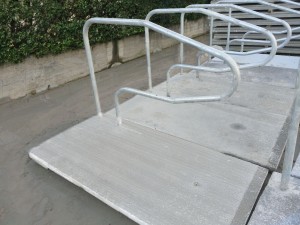
Cast for the job, not pulled off a shelf.
We have been casting concrete in North Devon for 53 years. Long-serving yard crew know what an awkward farm slab looks like, what a tight civils retaining job needs, and what a one-off conservation piece is worth taking on. We cast bespoke units alongside the catalogue range.
Bespoke precast wins where the job has an oddity: a non-standard retained height, a beam-bearing pocket, a curved face, an opening, a finish to match a listed building, or a service void that has to land in millimetre-tolerance.
Step 1 — Send us the drawing.
Send us a sketch, a photo of an existing unit, an engineer's drawing, or just a description on the phone. We do the rest. Bespoke geometry takes longer to price than a catalogue item.
Step 2 — Design to Eurocode 2.
Every bespoke structural unit is designed in-house to Eurocode 2, with crack-width control principles applied where liquid retention is involved (slurry tanks, water tanks, push-walls). Our products are manufactured in compliance with applicable British Standards, with the right exposure class for the duty — for information regarding the specific standards applicable to a particular product, please contact us.
Step 3 — Mould fabrication.
A bespoke mould is built in our yard from steel, plywood or GRP — whichever holds the form best at the volume. A simple flat-faced panel reuses standard formwork. A curved or pocketed unit takes longer to fabricate, and a complex mould longer still — please call to check current lead times.
Step 4 — Rebar fix and pour.
Reinforcement cages are tied off-mould and lifted in once the mould is dressed and release agent applied. The pour follows our factory production control process: cube testing at the required frequency, slump tested at the mixer, cover checked before pour, dimensional record at demould.
Step 5 — Demould and cure.
The mould is stripped once the unit has taken its initial set, then it cures to suit its duty. Units built to slurry specification cure fully before they see any load. Each unit is marked with a casting reference that ties back to the batch record and the declaration of performance.
Step 6 — Transport.
Loaded onto an artic or rigid lorry (or a low-loader for tall items) and delivered to your slab. We deliver across the UK and into Europe. You'll need a forklift, telehandler or crane on site to unload; tell us what you've got booked when we confirm the delivery slot.
Have a bespoke job in mind?
Send the sketch — we'll come back with a written quote.