
- Made in North Devon since 1973
- BSI Kitemark ready-mixed concrete
- Manufactured to applicable British Standards
- UK-wide & European delivery
Agricultural · dirty water
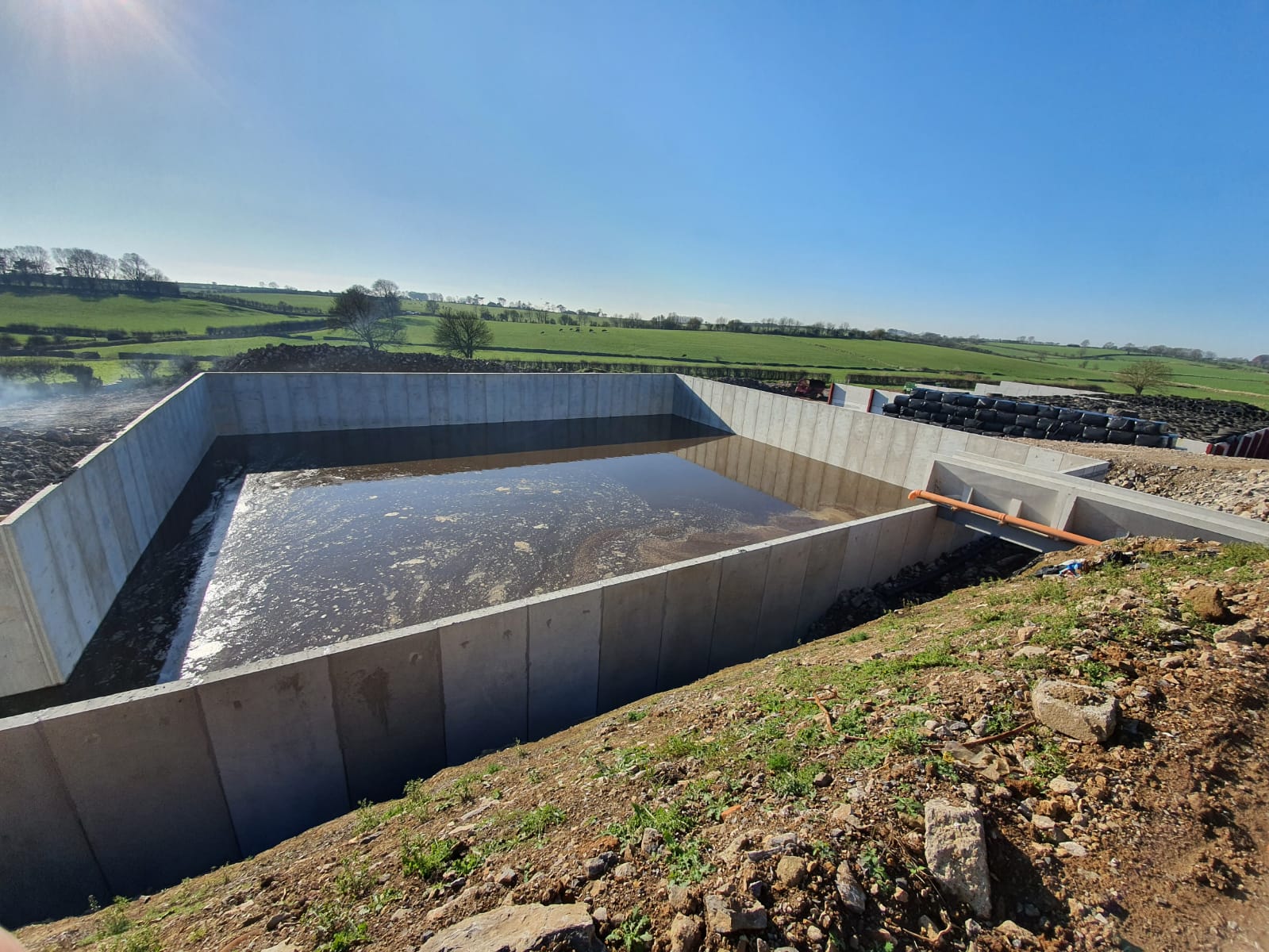
Dirty Water Tanks.
Sectional precast panels. Built chamber by chamber.
A sectional precast panel system for storing dirty water separately from slurry — yard washings, parlour washdown and contaminated runoff. Side walls are cast on a dedicated bed with a fixed 8ft (2.4m) width; height is made to order up to a maximum of 8ft (2.4m). Built up into a three-chamber, 25ft (7.6m) tank as standard, or extended with additional chambers to order.
Panels go up one at a time on base pads, each joint sealed with mastic and pulled square with retaining bars. Once the run is standing, the floor is cast in situ and the internal joints are mortared — same system whether it's a three-chamber tank or a longer run.
- · Fixed 8ft width, height to order
- · 3-chamber standard (25ft)
- · Extendable chamber runs
- · Mastic-sealed joints
- · Site-cast floor
Specification
Fixed width, height built to order.
Side walls are cast to a fixed 8ft (2.4m) width; height is made to order up to a maximum of 8ft (2.4m). Three chambers is our standard configuration; longer runs use the same panels and joint detail.
| Variant | Size | Detail | Typical use |
|---|---|---|---|
| Side-wall width | 8ft (2.4m) — fixed | Set by the rebate positions on the casting bed | Every tank, no variation |
| Panel height / chamber depth | Up to 8ft (2.4m), made to order | Cast using timber side formers — any height up to the maximum | Sized to your capacity requirement |
| Three-chamber tank | 25ft long (7.6m) | 8ft-wide chambers × 3 | Standard configuration |
| Extended runs | Additional chambers to order | Same panel and joint system, more chambers | Four-chamber and longer runs built to order |
Chamber-by-chamber capacity, concrete mix and any project-specific standards are confirmed with the order pack — send us the number of chambers and the site details and we will come back with a structural specification.
On site
How it goes together.
It's a panel build, not a single pour. Panels stand one at a time on base pads, each joint mastic-sealed and pulled square with retaining bars, and the floor is cast in situ once the run is standing.
- 1 Start on a firm, level surface — a compacted base or pre-cast tank pads.
- 2 Panels are stood one at a time on the base pads, each recess sealed with mastic before the next panel goes in.
- 3 A holding bracket fixes the first joint; retaining bars are inserted and tightened as each chamber squares up.
- 4 The sequence repeats along the run — mastic to every exposed recess, panel positioned, bars tightened.
- 5 Once every panel is up, bars are checked for tightness before the floor goes in.
- 6 A concrete floor is poured in situ and a sand-and-cement mortar is applied to the internal joints to finish.
Where they go
Common applications.
- · Dirty water storage separated from thicker slurry — yard washings, parlour washdown, roof and gulley runoff
- · Staged / multi-chamber settlement ahead of irrigation or further treatment
- · New-build and retrofit dirty water systems as part of an NVZ storage upgrade
- · Extensions to existing chamber runs using the same panel and joint system
From the field
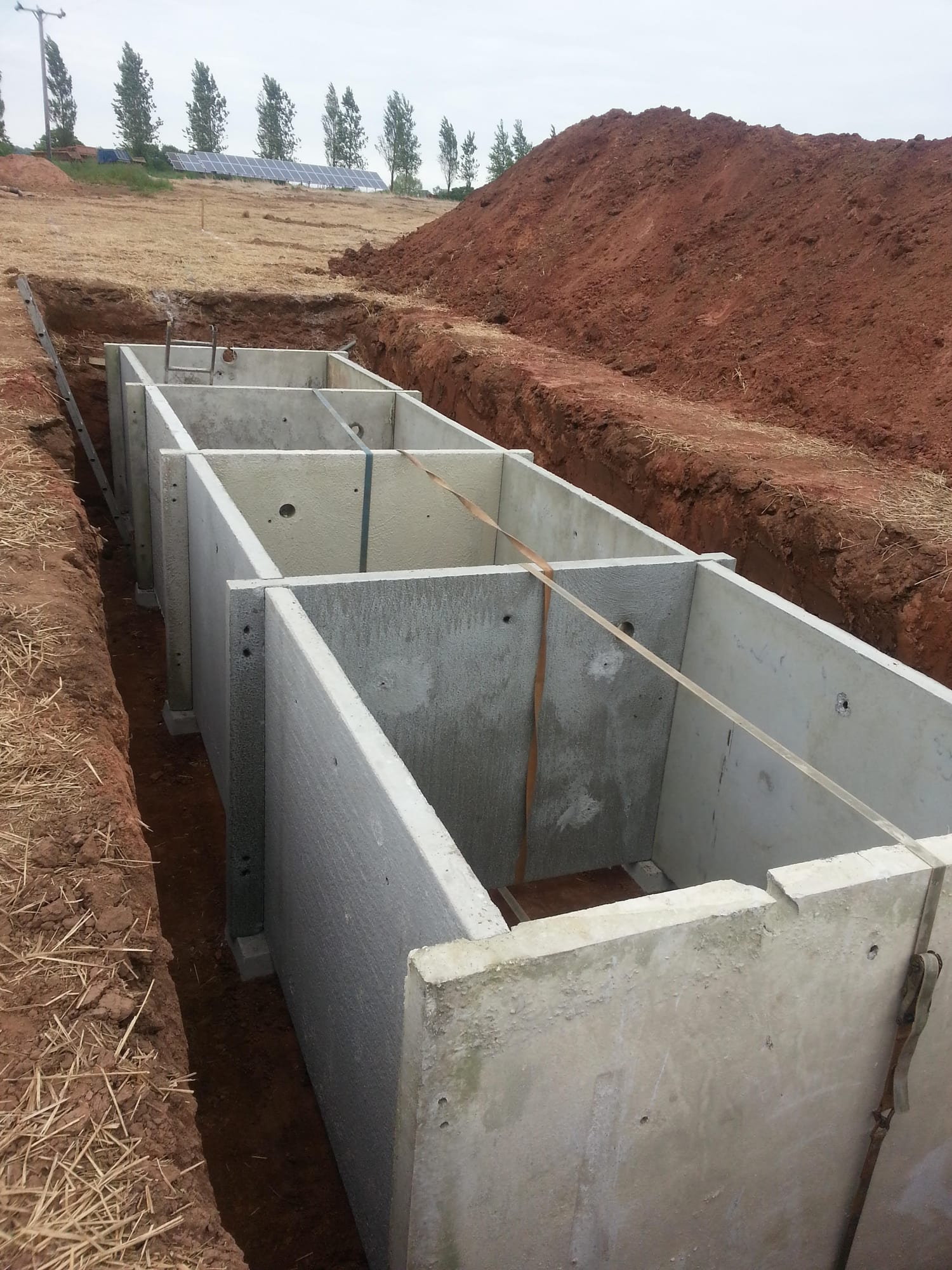
A four-chamber tank, in the trench.
Configure your dirty water tank
Tell us how many chambers and where it's going — we will quote it.
Related products
Often ordered alongside.
Specification sheets
Concept drawing and install guide.
The 8ft three-chamber concept drawing and the panel-by-panel installation guide.
Ready to specify it?
Send us the number of chambers and the site details. We will come back with a quote and a lead time.